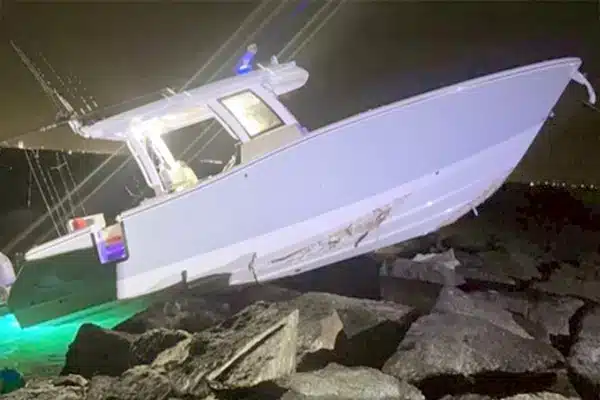
A defining feature of our marine accident work at ATA Associates, Inc. is a systems engineering perspective—an approach that treats each boating mishap not as an isolated failure, but as the outcome of interacting components within a larger system. In the marine environment, that system includes the vessel and its subsystems, the operator, passengers, and the surrounding conditions. By examining how these elements influence one another, we develop reconstructions that reflect the full complexity of real-world events.
At the core of our approach is the recognition that no single factor typically explains an incident. Outcomes emerge from the interaction of multiple variables: vessel speed and geometry, steering and propulsion characteristics, operator inputs, visibility constraints, and environmental influences such as channel curvature or water conditions. Our methodology is designed to capture and integrate these variables rather than isolate them. We combine physical inspections of the vessels and their damage patterns with eyewitness accounts and other available data sources such as onboard navigation systems.
Data plays a central role in our systems-level analysis. Modern vessels often carry GPS equipment capable of recording time-stamped position information, which can be used to reconstruct a boat’s path and speed leading up to an incident. We supplement this information, when necessary, with testing of exemplar vessels equipped with sensors that measure acceleration, orientation, and dynamic loads.
These measurements provide insight into how forces develop during maneuvers such as turns or rapid deceleration, helping us explain occupant motion and loss of control in ways that are consistent with fundamental physical principles.
We also place significant emphasis on the interaction between human and machine. Operator behavior must be evaluated in the context of the vessel’s capabilities and limitations, including perception/reaction time, field of view, and familiarity with the equipment. Understanding how a propulsion system behaves when throttle is reduced, or how a steering system responds under failure conditions, is essential to determining whether an operator’s actions were effective or constrained by the system itself. This integration of human factors with mechanical analysis is central to our work.
Environmental context is another critical component. We incorporate site-specific information through surveys and aerial imagery to recreate the setting of an incident. This allows us to analyze line-of-sight limitations, channel geometry, and other spatial relationships that influence vessel interaction and decision-making. In cases involving limited visibility or nighttime conditions, we may conduct additional testing to replicate lighting and perception challenges present at the time of the event.
As boating technology continues to evolve, we increasingly see a gap between the sophistication of individual components and the way those components are integrated into the finished vessel. Advanced propulsion systems, electronic controls, and navigation technologies offer significant benefits, but they can also introduce new and sometimes poorly understood interactions. In our experience, insufficient attention to system-level integration—how these technologies work together under real operating conditions—can contribute to unexpected behaviors that play a role in accidents.
Once the relevant elements are defined, we integrate them into comprehensive models that describe the sequence of events leading to a mishap. Using advanced measurement tools and digital modeling techniques, we create accurate representations of vessels and accident scenes that allow us to test hypotheses and refine conclusions. The resulting reconstructions are dynamic analyses that account for the interplay of forces, movements, and decisions over time.
By applying this systems engineering perspective, we move beyond surface-level explanations and develop a deeper understanding of boating accidents. Our goal is to account for the full network of contributing factors and provide a technically grounded explanation of how and why these incidents occur.